Nylon zippers
We make wholesale nylon coil zippers in Istanbul for coats, bags, luggage, home textiles and outdoor products. If you need a light, flexible zipper that follows a curved seam, you are in the right place.
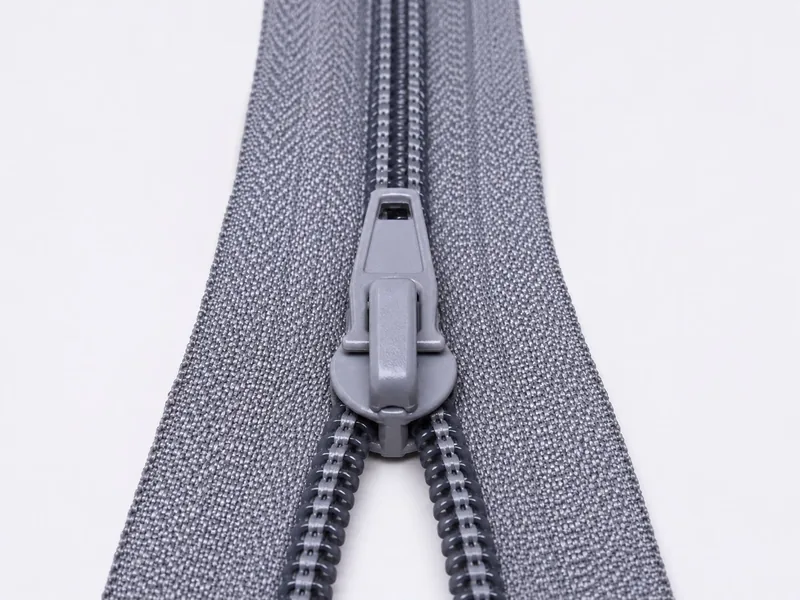
What a nylon coil zipper is
The teeth on a nylon zipper are not fitted one by one. A single filament is formed into a coil, then sewn to the tape or woven in with it, hence the name coil or spiral zipper. Despite the name, most of that filament in the industry is polyester, but the trade still says “nylon”, so we do too.
The coil gives the zipper two clear strengths: it is light and it flexes. It follows curved seams, does not drag on fine fabric and adds very little weight. This page covers coil construction; for zippers with individually formed teeth, see our molded zipper page.
It has its watch-outs too. The cut end of the coil can stay sharp, and if the left and right sides are sewn at different tensions the zipper will bow. Checking your cutting and sewing setup on a sample before production saves trouble later.
MAK Zipper has been making nylon zippers to world standards in Istanbul since 2005. Our 20-plus years of craftsman experience are at work in our Esenyurt factory, sales run through our Mercan store, and we ship wholesale worldwide, led by Türkiye and the Balkans. For more background, see our coil zipper guide.
- Product
- Nylon coil zippers, wholesale
- End types
- Closed-end, open-end (separating), two-way
- Finishes
- 17 finishes for pullers and metal parts
- Puller
- Metal, plastic and other types
- Tape
- 32 colours; ask us about others
- Size
- Size 3 / 5 / 7 / 8 / 10
- Made in
- Esenyurt, İstanbul
- Sales store
- Semaver Sokak No: 21, Mercan, Fatih, İstanbul
Where nylon zippers are used
Its lightness makes coil useful across many industries. These are common starting points rather than fixed rules. Our guide to choosing by end use has more examples.
- Coats and jacketsOn lighter garments you barely notice the teeth. Separating models open the front fully, and two-way versions give long coats more freedom of movement.
- Skirts, dresses and light garmentsOn fine fabric, a narrow and flexible chain works without disturbing the seam. Try the size against your fabric weight using a sample.
- Bags and backpacksCoil turns rounded corners easily. Hard-working bags often use a bigger chain and a non-lock slider.
- Luggage and travel goodsClosed two-way models are common because they give access from both sides. On heavily loaded products, choose the size with the load in mind.
- Home textiles and upholsteryCushions, duvet covers and seat pads call for a plain, light zipper close to the fabric colour, usually with a non-lock slider.
- Tents and outdoor gearDoors, awnings and sleeping bags benefit from sliders that work from both sides. The size depends on how big the product is and the load it carries.
End types
The end type sets what happens at each end of the zipper and how it opens. On coil, those end parts can be metal or plastic, so they are chosen for function and looks alike.
- Closed-endThe two sides are joined at the bottom. A simple, common choice for cushions, bag pockets, skirts and trousers, or anywhere that does not need to come fully apart.
- Open-end (separating)A pin and box let the sides part completely, mostly for coats and jackets. A film on the tape end stops it from fraying.
- Two-wayTwo sliders let the zipper open from either direction. Common on long coats, luggage, tents and sleeping bags, in separating or closed form depending on the product.
The top stop also covers the sharp end of the coil, which is why plastic top stops and a hand check of the edges matter on baby and children's products. Whether stops are metal or plastic comes down to the look and conditions of use.
On lighter separating models, the plastic pin and box carry less load than those on larger sizes, so heavy coats call for a more generous choice. Our article on end types goes into more detail.
The closed two-way models used on bags and luggage come in two general layouts known as O and X. The O closes when the sliders touch; the X closes when they are furthest apart. Our X and O guide shows the difference. Describe the opening you want when you order, since a term like “two-way” can be used for different things.
Choosing the slider and puller
On a coil zipper, the slider is the body that rides along the coil and closes it, and the puller is what you grip. How the product is used decides the right pairing.
Slider types
These are the slider types you will meet most often on coil zippers:
- Non-lock: slides freely. Preferred on luggage, bags and upholstery that open often.
- Auto-lock: stays in place when you let go, which stops coats, jackets and sportswear from creeping open.
- Reversible: the puller swings to either face, for tents and sleeping bags that open from inside and out.
- Double-pull: a puller on each face.
Sliders also differ by material. Zinc alloy (zamak) bodies are among the most common. Plastic is light and resists corrosion, so it is often suggested for salt water and damp conditions. On small sliders, forcing the lock can damage the mechanism.
A slider made for coil will not fit metal or molded plastic teeth, and size and type must match together; see our article on slider fit, or our slider guide for the types in detail. The full range of metal and plastic sliders and pullers is on our sliders and pullers page. Note your preference in the form and we will settle the option with a sample.
Pullers
Common puller types:
- Hooked metal: Hooks onto the slider, with the widest choice of models.
- Looped metal: Easy to grip thanks to its ring opening, common on leather and denim.
- Plastic: Light and colourful, common on sportswear and home textiles.
- Rubber and silicone: Easy to grip, common on outdoor and sports products.
- Leather and imitation leather: Gives a softer finish on leather garments and bags.
- Wire, string and cord: Light and plain, and helpful on products used with gloves.
The puller finish comes from our metal catalogue, so it can match the other metal hardware on your bag or coat.
Across the market, coil zippers use plastic, rubber and cord pullers as much as metal ones. On outdoor products a longer puller is easier to use with gloves, while home textiles tend to favour something small and discreet.
Our puller article covers the options in more depth.
Coil colour and finishes
Coil is not plated the way metal teeth are. It takes its colour from the material and can be produced to match the tape. Finishes apply to the puller and other metal parts.
How to choose the look
Tone on tone: matching coil and tape lets the zipper disappear into the fabric, the usual choice for home textiles and understated garments.
Contrast puller: the tape stays plain while a puller in, say, antique brass or gunmetal adds a small metal accent.
Metallic look: metal-effect coil also exists on the market. If that is what you are after, tell us the end use and we will let you know where we stand.
You can try puller and tape pairings in our catalogue.
Tape and colour
With coil zippers the tape does most of the visual work, because the coil usually follows the same colour. That makes colour matching more decisive here than on metal.
We show 32 tape colours here. If you need something else, send a fabric swatch or colour code. Colours look different under different lights, so decide with the sample next to your fabric in daylight.
Most tape in the industry is polyester. Cut edges can fray, so keep cuts clear of the chain. On PVC and imitation leather, dark tape dye can migrate into the surface over time, so check for this in bag and accessory production.
One distinction for outdoor products: a water-repellent tape and a waterproof zipper are not the same thing. Our article on water-repellent and waterproof zippers explains the difference. If you need either, tell us the end use and we will discuss the options.
Contact us about a custom colourOn-screen colours are indicative only. Request a sample for the exact colour.
Sizing: what Size 5 means
We give coil zipper sizes by number too: Size 5 means the same as international No. 5 or #5. In Türkiye you will also see it written as Tip 5, T5 or 5 numara.
We confirm the exact millimetres on a sample. Tell us about your product, your fabric and the zipper you use now, and we will choose the right size together.
Ordering nylon zippers wholesale
A wholesale coil order starts with a sample. The steps are simple.
Send your request
Fill in the sample form or contact us on WhatsApp.
Confirm the details
Our team goes through end type, size, finish and tape with you.
Try the sample
We prepare and ship your sample. Try it on your fabric and in your wash.
Go to production
With your approval, production starts and your order ships from our factory.
Nylon zippers: common questions
How durable are nylon zippers?
It depends on size, tape and construction. Heavy-use products such as luggage take a larger size. Tell us about your product and we will settle the right option with a sample.
Can the coil match the tape colour?
Yes, the coil can be produced to match the tape. Specify your colour on the sample request.
Should I choose metal or nylon?
Choose metal if the look and finish matter most, and coil if lightness and curved seams do. Durability is not about type alone; it also depends on size and construction.
Which nylon zipper suits a coat?
Usually a separating model with an auto-lock slider, or a two-way version on long coats so the hem can open too. We can choose the size together based on the weight of the fabric.
Is Size 5 the same as No. 5 or #5?
Yes. Size 5 follows the international number scale, so it means the same as No. 5 or #5. In Türkiye it may be written as Tip 5, T5 or 5 numara. We confirm the exact millimetres on a sample.
Are waterproof and water-repellent zippers the same?
No. A water-repellent zipper sheds water from the tape, but some can still get through the chain, while a waterproof construction is a different product group. If you need either, tell us the end use.
Do you export nylon zippers?
Yes. We ship wholesale worldwide, led by Türkiye and the Balkans.
Have another question? Please contact us.
Chat on WhatsAppFeel the difference in your hand.
Test the quality yourself, then decide. We will get back to you as quickly as possible.